Agile Companies Need Both Freedom and Discipline

True agility is not about abandoning structure. Research suggests that companies need an agile culture that allows for creativity, market focus, and disciplined execution.
In 2024, Intel CEO Pat Gelsinger emphasized the need to transform the company’s culture to make it leaner, simpler, and more agile. But by the time Gelsinger left the company two years later, it had become evident that changing the company’s culture was far more complex and demanding than initially anticipated. That’s not surprising. It’s known that a major reason for merger and acquisition failures is differences in organizational culture between the firms involved.
Organizational culture is a strategic asset that shapes behavior and decision-making, influencing an organization’s agile mindset and overall performance. When strong, it aligns employees with strategy, encourages innovation, and sets the firm apart. Perhaps the clearest way to understand organizational culture is to think of it as a company’s “personality,” guiding how it behaves, makes decisions, and responds to challenges. But achieving this ideal is difficult because companies must balance the need for stability and the imperative to take bold risks and innovate. They must launch new products while simultaneously maintaining existing ones, balance spontaneity and intuition with discipline and comprehensive planning, and move into the future while honoring the past.
My research into this topic shows that managers can honor all these imperatives, and become more agile not by downplaying any of them but by getting them to work together in the best possible way.
Why Change is Challenging
Just as understanding or changing a person’s personality can be difficult, grasping a firm’s culture and changing it is no easy task, as the many failed merger & acquisition efforts can attest. In many cases, managers discover that organizational culture is a far more critical make-or-break factor than strategy or technology. Moreover, cultural differences, such as hierarchical versus clan-oriented norms, can block change even when technologies or strategies are complementary. Therefore, mergers and acquisitions should evaluate cultural alignment as carefully as financial, strategic, or technological fit.
Another issue is that managers and entrepreneurs frequently hear the directive to be agile, but often don’t completely understand what this requires. Agility is frequently associated with software development methods, such as Scrum and Kanban. While effective in their original context, these frameworks represent only a narrow, operational view of agility and fall short of capturing what agility means for organizations more broadly.
Researchers have defined agility as a firm’s ability to respond quickly to market changes, whether triggered by new technologies, emerging opportunities, or shifting customer needs. My research on agility, published in International Marketing Review (with Aviv Shoham and Luis Filipe Lages), showed empirically that agility is a key driver of new product success. Moreover, our research shows that planning and agility are not mutually exclusive. In fact, we demonstrate that effective strategic planning helps organizations prepare for multiple scenarios, enabling them to respond more quickly and in a more agile manner when market changes occur.
However, speed of response alone is not sufficient. Before firms can act agilely, they must think agilely. This requires a mindset in which change is viewed as an opportunity rather than a threat. From this perspective, agility is not merely a capability or a set of processes, but a strategic intangible resource embedded in the organization. An agile mindset is a critical resource that enables firms to adopt new management practices and encourages organizational members to explore innovative approaches.
Competing Cultures Can Actually Be Complementary
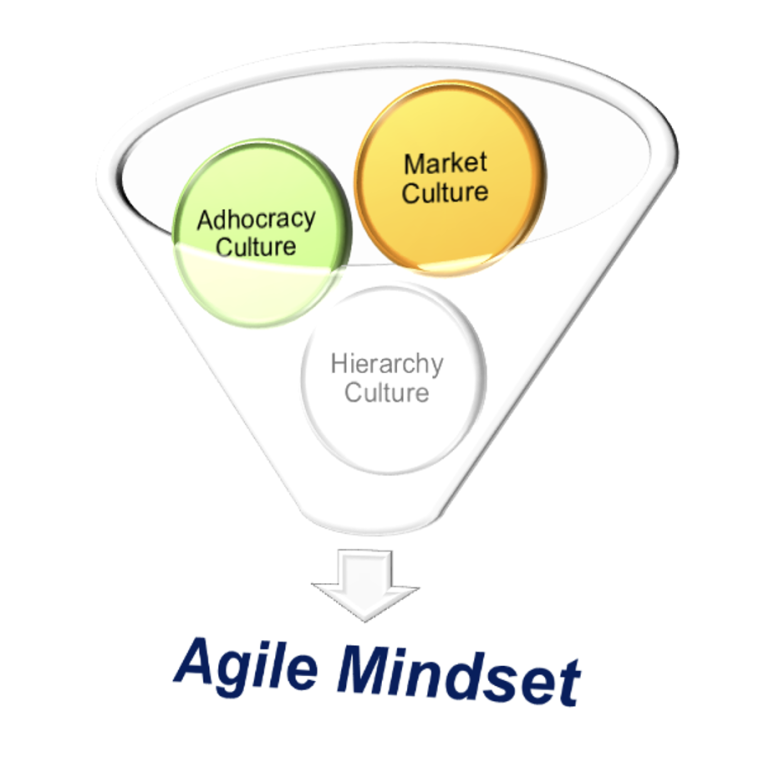
My new research paper published in the Review of International Business and Strategy (Asseraf & Gnizy, 2026) shows that fostering an agile mindset is not about adhering to a single dominant culture or choosing one culture after another; rather, it involves mastering the right combination and balance of competing cultures. We saw that three subcultures -- market, adhocracy, and hierarchy cultures (Cameron & Quinn 2011) – help nurture an agile mindset. Together, these elements create conditions for agility to emerge, not despite their differences but because of them. Each type of organizational culture contributes a different element to an agile mindset:
- Market culture: prioritizes goal achievement, competitiveness, and strategic direction
- Adhocracy culture: emphasizes creativity, risk-taking, and adaptation
- Hierarchy culture: relies on formal rules and policies to maintain stability and coordination
The interplay between these three cultures are similar to how a well-balanced meal depends on the careful integration of different flavors and ingredients. Market culture contributes to an agile mindset by ensuring that the organization remains focused on goals and strategic direction. Without it, the organization may fail to reach its intended strategic destination.
Adhocracy culture contributes to an agile mindset by fostering creativity and risk-taking, enabling organizations to embrace change. However, without market culture, adhocracy may lead to excessive innovation that is insufficiently aligned with strategic objectives.
Finally, hierarchy culture supports an agile mindset by enabling smooth, structured, and efficient operations. Without it, agility may result in processes or products that are excessively costly or operationally unsustainable. For example, OpenAI reportedly discontinued its Sora video application shortly after launch, reflecting the necessity of making trade-offs when costs become too high relative to strategic priorities.
The Pitfalls of Consensus
Our research also revealed that clan culture, which fosters trust and commitment among employees and is often viewed as an extended family, does not contribute to an agile mindset. Excessive focus on consensus can stifle experimentation and hinder rapid adaptation. However, a hierarchy culture can actually contribute to an agile mindset. This is because it provides structure, clear roles, and consistent processes, which paradoxically enable teams to respond more quickly since everyone understands the boundaries and expectations.
So how can organizations shape their cultures to support an agile mindset? I argue that a good starting point is to recognize and adopt organizational cultures that seem to be at odds with one another. Managers should deliberately cultivate and balance competing cultural logics rather than emphasizing a single dominant one. They might carefully apply the following recommendations:
- Reduce clan culture by moving away from excessive consensus and prioritizing organizational objectives over individual preferences, even in family oriented environments.
- Strengthen adhocracy culture by institutionalizing experimentation and systematically incentivizing innovative behavior.
- Strengthen hierarchy culture by establishing robust performance monitoring and evaluation systems and enforcing accountability mechanisms.
- Strengthen market culture by using market data and competitor analysis to guide contingency planning and decision making.
From a Family-Like Culture to Global Agile Leadership
In their recent book, The Secret of Culture Change, Barney et al. (2023) emphasize that it is particularly valuable to learn about culture changes from managers who have successfully implemented them within their own organizations. One example of a successful transformation comes from an Israeli firm that evolved from a non-profit organization primarily engaged in defense-related R&D, characterized by a creative and informal “family-like” culture, into a commercially oriented firm structured around professional divisions with an emphasis on international business.
The organization was established in 1948. As it aged it became more inefficient. By the late 1990s, it was clear that the organization was no longer suited to the new competitive environment and had to reinvent itself or shut down. According to the CEO: “In the years preceding the crisis, we did not lack groundbreaking ideas...ambitious goals and outstanding people were also not missing. What was lacking was an organizational architecture that could transform us into a high-performing firm capable of realizing the assets at our disposal” (Shalgi, 2020).
The CEO recognized that the company’s mindset and culture had to change if was to become an agile organization that could rapidly respond to opportunities in international markets and compete against global giants. The challenge was how to design a culture that would both nurture innovation and ensure the organization’s future, while at the same time creating a well-disciplined, execution-oriented organization for the present.
The solution was the design of an “Organizational Compass” program that simultaneously provided freedom and structured guidance, a form of “order within disorder.” On one hand, it offered creative employees the freedom needed to express their talents; on the other, it established the order and discipline necessary to manage ambitious tasks. The idea was to cultivate a culture that delivers on two seemingly opposing demands: freedom for creative people alongside the order and discipline required to execute large-scale global initiatives (paralleling the combination of adhocracy and hierarchy cultures).
In the initial stages of the change process, the following elements were defined:
- Ambitious global objectives. Achieving an annual turnover of USD 1 billion and emphasizing profitable, export-driven growth
- Concise strategic principles. Prioritizing an ambitious gross profit target, which allows for significant reinvestment in innovative projects, rather than focusing solely on net profit and
- Core values. Emphasizing courage and innovation, along with a willingness to make difficult decisions, including staff reductions.
During the implementation process, potential sources of resistance were anticipated, and methods were developed to manage internal frictions, such as active listening, openness, and willingness to admit mistakes. Special emphasis was placed on defining simple and easily understood organizational goals and on engaging all managerial layers reporting to the vice presidents. Additionally, an organizational structure aligned with the new strategy was introduced, strengthening the autonomy of strategic business unit managers, who became the company’s spearhead. Moreover, management held periodic review meetings for two years to monitor the implementation of strategic goals and core values. In addition, a group of “seeders” was identified and granted full freedom to act as they saw fit, provided their actions aligned with the Organizational Compass as they interpreted it. Furthermore, an “innovators’ community” was established, including employees from all organizational levels, emphasizing diverse personalities involved in every decision.
The Organizational Compass program shaped the executive agenda, enabled rapid decision-making, and balanced the freedom needed for innovation with broad managerial authority. The result was a cultural transformation that reinforced the company’s global position and enhanced its organizational agility, manifested in shorter time-to-market for new products, reduced costs, and mitigated risks associated with breakthrough innovation.
According to the CEO, “The leap in business performance would not have been possible without a parallel shift in the organization’s mindset and culture” (Shalgi, 2020).
Three Important Takeaways…
- Agile mindset requires balancing competing values, not choosing between them. The case shows that agile mindset emerges from the deliberate integration of market (clear goals and direction), adhocracy (creativity, autonomy, experimentation) and hierarchy (discipline, control, execution), rather than privileging one cultural logic over the other.
- Paradoxical culture must be actively designed and governed. Through simple principles, goals, and review mechanisms, managers can institutionalize cultural paradoxes, allowing an agile mindset in the form of freedom within boundaries (see “Responsible Creativity: Turning Ideas into Business Reality”), thereby enabling fast decision making and coordinated action.
- Empowerment drives both innovation and accountability. By granting SBU managers autonomy and creating dedicated “seeders” and an “innovators’ community,” the organization demonstrated that a paradoxical culture can empower individuals to experiment and innovate, reflecting an agile mindset, while still aligning their actions with strategic objectives.
…And, Most Importantly:
Agility is not the result of cultural purity. It is the outcome of managing tensions across competing values. An agile mindset requires order within disorder. Organizations that can hold this balance are better positioned to perform in complex international environments. Leaders can empower innovation while keeping teams aligned with strategic goals, showing that cultural transformation, though challenging, can successfully drive agility.
References
Asseraf, Y., Lages, L. F., & Shoham, A. (2019). Assessing the drivers and impact of international marketing agility. International Marketing Review, 36(2), 289-315.
Asseraf, Y., & Gnizy, I. (2026). Agile mindset in international business: the case of organizational culture and behavioral performance. Review of International Business and Strategy. 1-24.
Barney, J. B., Amorim, M., & Júlio, C. (2023). The Secret of Culture Change: How to Build Authentic Stories that Transform Your Organization. Berrett-Koehler Publishers.
Cameron, K.S. & Quinn, R.E. (2011), Diagnosing and Changing Organization: Based on the Competing Values Framework. A Jossey-Bass Reader, John Wiley and Sons.
Shalgi G. (2020). The Organizational Compass: Leveraging crisis into Business Success. ContentoNow. Tel Aviv.